
March 6, 2026
Xiaomi Miclaw: Revolutionary Mobile AI Agent Redefining Smartphone Automation in 2026
Key Takeaways
- Xiaomi miclaw represents Xiaomi's entry into advanced mobile AI agents, built on the proprietary MiMo large language model for intent understanding and autonomous execution.
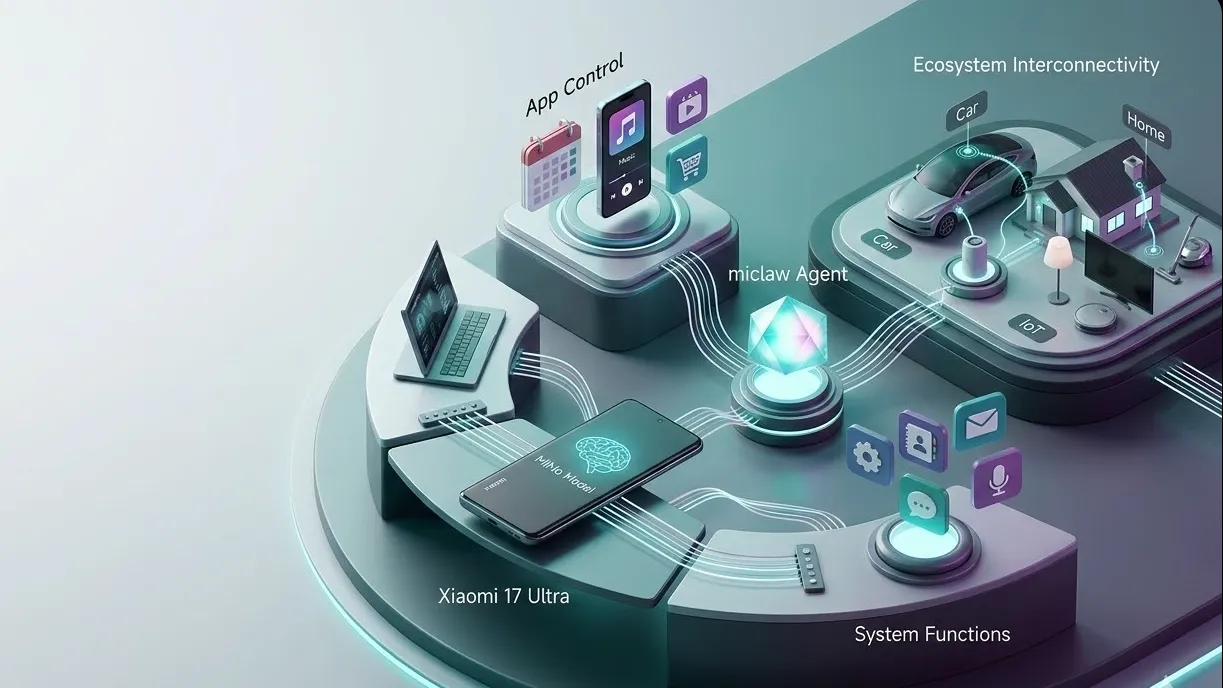
- Unlike traditional assistants, miclaw operates as a system-level tool, autonomously calling over 50 system functions, third-party apps, and Xiaomi ecosystem devices with user authorization.
- Currently in limited closed beta (invitation-only, no public recruitment), it supports select Xiaomi 17 series smartphones including Xiaomi 17, 17 Pro, 17 Pro Max, 17 Ultra, and 17 Ultra Leica Edition.
- Core strengths include deep personal context awareness, ecosystem interconnectivity across human-car-home scenarios, and self-evolution through a multi-tier memory system that learns without using personal data for training.
- Strong emphasis on privacy: sensitive operations require explicit confirmations, no payment tools are registered by default, and core data processing occurs on-device via end-cloud privacy computing.
- Benchmarks and demos indicate potential for complex multi-step workflows, though stability, power consumption, and success rates in edge cases remain under optimization.
What Is Xiaomi Miclaw?
Xiaomi miclaw stands as an experimental AI interaction product launched in early March 2026, marking a significant advancement in mobile agent technology. Powered by Xiaomi's in-house MiMo large model, this system transforms smartphones into proactive digital agents capable of interpreting vague user intentions and executing tasks independently.
Analysis shows that miclaw moves beyond conventional voice assistants by integrating deeply into the operating system (HyperOS foundation). It employs a reasoning-execution loop to break down commands, select appropriate tools, and perform actions across apps and services.
Core Capabilities and Technical Architecture
Benchmarks indicate four layered strengths that set miclaw apart:
- System-Level Underlying Abilities — Encapsulates phone capabilities into more than 50 tools (expandable), enabling direct access to system functions without relying solely on app interfaces.
- Personal Context Understanding — Maintains awareness of user habits, history, and on-screen context for more accurate intent interpretation.
- Ecosystem Interconnectivity — Seamlessly controls Mi Home (米家) IoT devices, supports MCP protocol for PC tools, and allows third-party apps to declare capabilities via SDK for proactive invocation.
- Self-Evolution — Features a three-tier intelligent memory system that retains key decision points, compresses redundant conversations, and caches core instructions locally. This enables continuous improvement, with token optimization reducing consumption by 50-90% in extended interactions.
Community feedback and official demos highlight real-world examples like analyzing bank SMS for subscription detection (potentially saving users ~400 CNY annually) or coordinating multi-device actions with single commands.
How Xiaomi Miclaw Compares to Global AI Agents
Comparisons reveal conceptual similarities to agents like OpenClaw (often nicknamed "lobster" or "龙虾" in Chinese communities), particularly in architecture for autonomous task handling. However, miclaw differentiates through mobile-first design:
- Faster on-device deployment without complex setups.
- Native integration with Xiaomi's vast ecosystem for effortless smart home and cross-device control.
- Accessibility for non-technical users via simplified authorization flows.
While global agents may excel in certain open environments, miclaw prioritizes seamless Xiaomi hardware-software synergy, potentially offering superior performance within its ecosystem.
Privacy and Security Features
Security remains a priority in miclaw's design. Sensitive permissions (contacts, SMS, calendar) require runtime authorization. High-risk actions like sending messages or creating events trigger per-execution confirmation dialogs with 60-second auto-reject timeouts.
No payment, transfer, or ordering tools exist in the codebase by default—such functions demand explicit user verification (fingerprint, password). User interactions serve only real-time execution; data avoids training pools, with sensitive processing handled locally through end-cloud privacy computing.
Current Availability and Beta Limitations
As of March 2026, miclaw operates under a strictly invitation-only closed beta, targeting tech enthusiasts and power users. No public sign-ups exist, and testing focuses on Xiaomi 17 series devices.
Official statements emphasize ongoing refinements in stability, battery impact, and complex scenario reliability. High-difficulty tasks may show execution fluctuations or temporary failures, making it unsuitable as a daily driver without backups.
Advanced Tips and Common Pitfalls
For beta participants:
- Grant Precise Permissions — Start with minimal authorizations to test boundaries, expanding only as needed to avoid unintended executions.
- Use Clear Yet Natural Language — Vague commands leverage context understanding, but overly ambiguous ones may require clarification rounds.
- Monitor Resource Usage — Track battery and thermal performance during extended workflows; optimizations continue.
- Backup Before Testing — As an experimental build, potential instability warrants full device backups.
Common pitfalls include over-relying on unproven complex chains (risking partial failures) and neglecting confirmation prompts in high-sensitivity scenarios.
Conclusion
Xiaomi miclaw signals a bold step toward truly autonomous mobile AI, blending powerful intent recognition with ecosystem-wide execution. While still in early beta with refinement needed, its architecture positions Xiaomi competitively in the evolving AI agent landscape.
Tech enthusiasts with compatible Xiaomi 17 series devices should watch for invitation opportunities. For broader users, miclaw previews the future of proactive smartphone intelligence—stay updated on official channels for wider release developments.