
March 9, 2026
Tencent WorkBuddy Review 2026.3.10: The No-Setup Sandboxed AI Agent Transforming Office Productivity
Key Takeaways
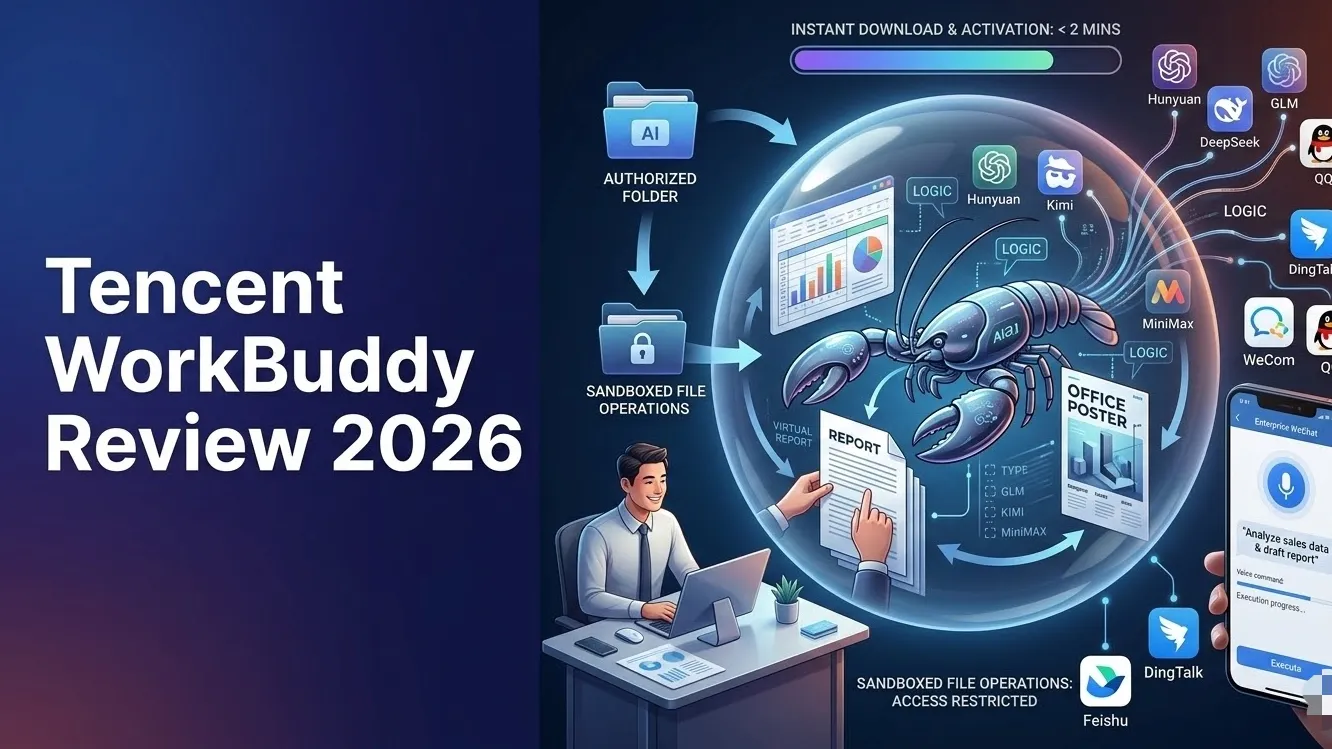
- Instant access: Download from the official site and begin automating tasks in under 2 minutes—no deployment or configuration required.
- Enterprise security first: Sandboxed file operations limit access to user-authorized folders only, with Docker/Podman local containers or E2B cloud isolation blocking dangerous actions.
- OpenClaw compatibility plus extras: Full skill import from OpenClaw alongside 20+ built-in packs, MCP protocol support, zero-code skill creation, and multi-agent parallel execution.
- Flexible models and integrations: Seamless switching between Hunyuan, DeepSeek, GLM, Kimi, and MiniMax; one-minute remote control via Enterprise WeChat plus native support for QQ, Feishu, and DingTalk.
- Proven at scale: Over 2,000 non-technical Tencent employees (HR, admin, operations, sales) have used it since February 2026 internal beta for real workflows like data analysis, report generation, and poster creation.
What Is Tencent WorkBuddy?
Tencent WorkBuddy is a full-scenario desktop AI agent launched by Tencent Cloud on March 9, 2026. Nicknamed the “Little Lobster” (Tencent’s take on the popular OpenClaw framework), it turns natural-language instructions into actual computer actions—reading documents, analyzing spreadsheets, generating reports, creating posters, and handling multi-step office tasks.
Unlike chat-only tools, WorkBuddy operates directly on the user’s desktop as an intelligent colleague. It supports local execution without mandatory cloud dependency, making it ideal for privacy-conscious enterprises.
Core Features and How It Works
WorkBuddy processes commands through a combination of large language model reasoning and sandboxed execution. Users simply type or speak instructions; the agent plans, breaks down complex tasks, and executes them safely.
Key capabilities include:
- Multi-agent parallelism: Complex jobs are dynamically split across multiple AI instances running simultaneously.
- 20+ built-in skill packs: Ready-to-use modules for information retrieval, content drafting, data analysis, poster generation, and automated reporting.
- MCP (Model Context Protocol) support: Enables structured context passing between models and tools.
- Skill expansion: One-click import of any OpenClaw skill or zero-code creation of custom abilities.
Example workflow:
"Analyze Q1 sales data in the Authorized folder, create charts, and draft a weekly summary report in Chinese."The agent locates files, processes data, generates visuals, and outputs the report—all within seconds.
Security: Sandboxed Execution That Enterprises Can Trust
Analysis of desktop AI agents shows one major risk: unrestricted system access. WorkBuddy addresses this head-on with a conservative sandbox design.
- Access restricted exclusively to user-authorized folders.
- Operations run in isolated Docker/Podman local containers or E2B-managed cloud environments.
- Dangerous commands are automatically blocked.
- Unified account system and comprehensive security audits provide enterprise-grade governance.
This architecture shifts AI agents from experimental tools to production-ready solutions. Internal tests confirm it safely handles sensitive HR documents and financial spreadsheets without exposing the broader filesystem.
Easy Installation and Remote Control
No technical setup required. Users visit the official page, download the desktop application, and start immediately. New users receive 5,000 free credits for task execution.
Remote control takes it further: connect via Enterprise WeChat in under 60 seconds. Managers can issue voice commands from mobile while the agent works on the office PC. Native integrations with QQ, Feishu, and DingTalk extend this flexibility across common Chinese enterprise ecosystems.
Advanced Use Cases and Productivity Tips
Benchmarks from Tencent’s internal rollout reveal dramatic gains for non-technical roles:
- HR & Administration: Automated employee data processing, onboarding report generation, and knowledge-base building.
- Operations & Sales: Real-time market monitoring, personalized content creation, and multi-document analysis.
- Creative workflows: One-command poster design and push-article drafting.
Pro tips for maximum results:
- Start with authorized-folder mapping for all recurring projects to minimize permission prompts.
- Switch models strategically: use DeepSeek or MiniMax for speed on routine tasks; Hunyuan or GLM for nuanced Chinese-language content.
- Leverage multi-agent mode for large reports—assign subtasks (data extraction, visualization, writing) to parallel agents.
- Combine with mobile voice input for on-the-go oversight during meetings.
Comparison: WorkBuddy vs OpenClaw and Other Desktop Agents
OpenClaw popularized local AI agents in China with over 250,000 GitHub stars, yet requires hours of configuration and often cloud hosting. WorkBuddy eliminates these barriers while retaining full skill compatibility and adding enterprise safeguards.
Compared to global alternatives (cloud-heavy computer-use agents), WorkBuddy excels in:
- Zero-deployment speed.
- Domestic model flexibility for cost and compliance.
- Tight integration with WeCom and Chinese productivity suites.
Community feedback indicates WorkBuddy delivers practical workflows faster than model-hype tools, particularly for teams already using Tencent’s ecosystem.
Common Pitfalls and How to Avoid Them
Early adoption highlights three frequent issues:
- Permission friction: New users sometimes overlook folder authorization. Solution: Pre-map project directories during first setup.
- Credit oversight: Free 5,000 credits deplete quickly on heavy multimodal tasks. Monitor usage in the dashboard and upgrade as needed.
- Model latency in complex chains: Switching to lighter models (e.g., MiniMax) for initial planning reduces wait times before handing off to stronger models.
Addressing these ensures smooth scaling from individual productivity to department-wide deployment.
Conclusion
Tencent WorkBuddy marks a pivotal shift from experimental AI chatbots to secure, actionable desktop agents. With instant deployment, robust sandbox protection, and deep enterprise integrations, it empowers both technical and non-technical users to reclaim hours previously lost to repetitive tasks.
Ready to experience the next generation of office automation? Visit the official WorkBuddy page, download the application, and start your first task today.