
March 7, 2026
Qwen-Image 2.0: Alibaba's 7B Unified Model Redefining Professional AI Image Generation & Editing
Key Takeaways
- Unified 7B Architecture — Combines text-to-image generation and precise editing in one model powered by an 8B Qwen3-VL encoder and 7B diffusion decoder, delivering faster inference than its 20B predecessor.
- Native 2K Resolution — Outputs sharp 2048×2048 images directly, capturing microscopic details in photorealistic scenes without upscaling artifacts.
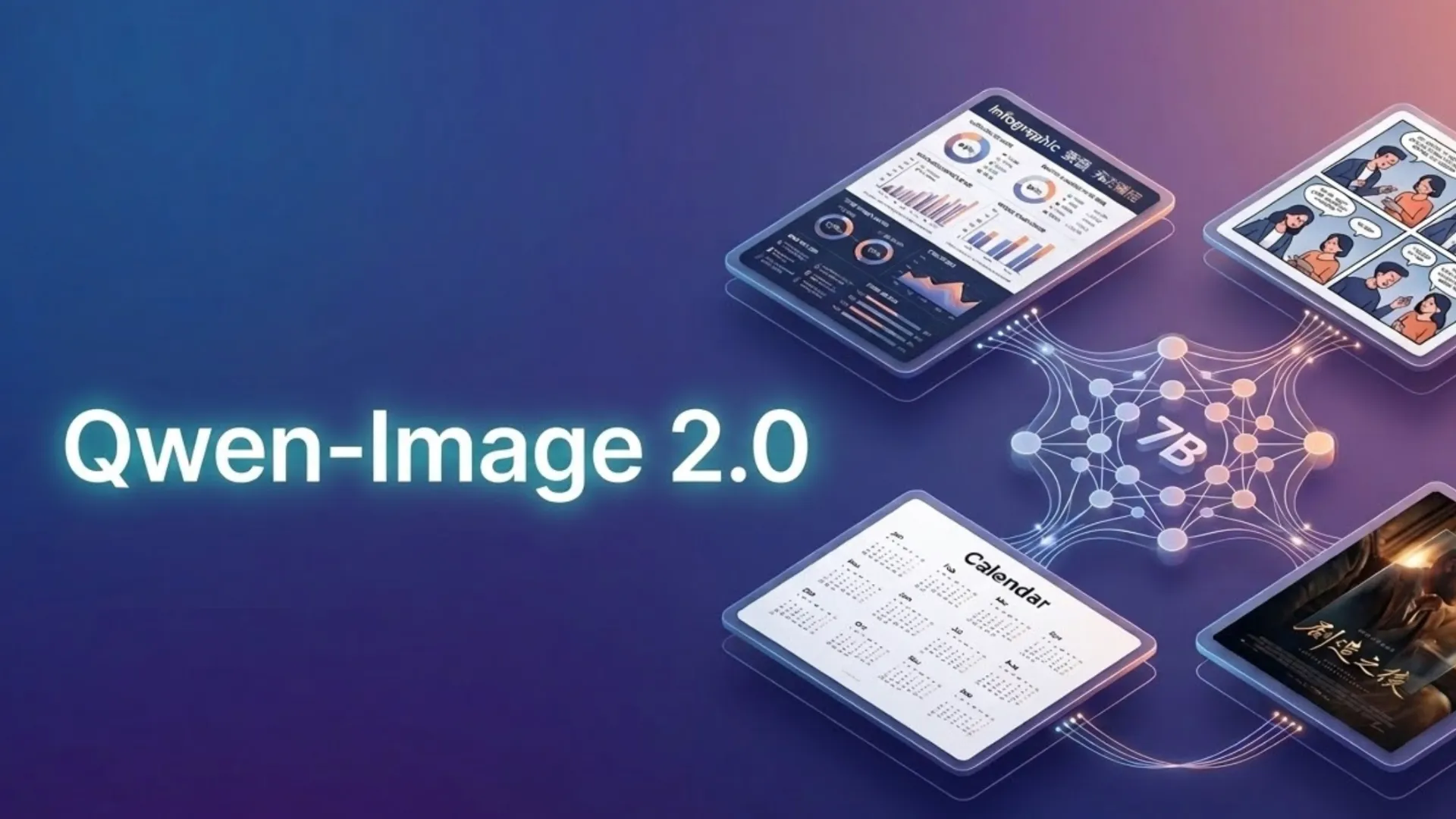
- Professional Typography — Handles up to 1,000-token prompts for complex infographics, PPT slides, posters, comics, calendars, and multi-style calligraphy with perfect alignment and legibility.
- Top-Ranked Performance — Leads AI Arena blind evaluations for both generation and editing; outperforms larger models on semantic adherence, realism, and instruction following.
- Seamless Workflow — Single model supports object insertion, style transfer, text editing in images, and multi-panel consistency — ideal for production pipelines.
Introduction to Qwen-Image 2.0
Alibaba’s Qwen team released Qwen-Image 2.0 on February 9, 2026, marking the convergence of separate generation and editing tracks into a single foundational model. Analysis shows this unified approach eliminates pipeline switching while achieving superior results in photorealism, typography precision, and editing consistency.
The model stands out for its ability to process long, structured instructions and render text on diverse surfaces — from glass to fabric — with publication-ready accuracy.
Evolution from Earlier Versions
Prior development followed two parallel paths. The generation track began with Qwen-Image in August 2025 (focused on text rendering) and advanced to Qwen-Image-2512 in December 2025 (enhanced photorealism). The editing track progressed from single-image edits in August 2025 to multi-image consistency improvements by late 2025.
Qwen-Image 2.0 merges these tracks. The result is a lighter yet more capable system where improvements in one area automatically benefit the other, explaining the leap in overall performance despite the parameter reduction.
Core Technical Features
Professional Typography Rendering
Qwen-Image 2.0 supports prompts up to 1,000 tokens, enabling direct generation of complex layouts including bilingual infographics, multi-slide PPTs, movie posters, and comic panels with dialogue bubbles. It accurately simulates calligraphic styles (Slender Gold, small regular script) and places text on curved or reflective surfaces without distortion.
This stems from integrated multimodal understanding: the vision-language encoder parses layout intent while the diffusion decoder ensures pixel-perfect alignment.
Native High-Resolution Output
The model generates at 2048×2048 natively. Benchmarks indicate this delivers finer details — skin texture, fabric weave, foliage gradients — compared to upscaled outputs from other models.
Unified Generation and Editing Pipeline
A single endpoint handles creation from text or modification of uploaded images. Dual encoders preserve original appearance and semantics during edits, supporting object addition/removal, style transfer, and multi-image consistency for storyboards or comics.
Lightweight Yet Powerful Design
Reduced to 7 billion parameters (from 20B), the model runs faster while scoring higher across metrics. The efficient Qwen3-VL encoder + diffusion decoder architecture optimizes for both quality and speed.
Benchmark Performance and Comparisons
Blind human evaluations on AI Arena place Qwen-Image 2.0 at the top for unified text-to-image and image-editing tasks. Third-party reports show it surpassing FLUX.1 (12B) on DPG-Bench and excelling in precision, complexity, aesthetics, realism, and alignment — the five core characteristics highlighted by the Qwen team.
The smaller size does not compromise capability; instead, targeted training on long-context instructions and high-resolution data drives the gains.
Practical Use Cases and Advanced Tips
Professional Visual Content Creation
Craft publication-ready infographics or presentations by including exact text, layout grids, color schemes, and chart data in the prompt. The model renders bilingual text and complex tables flawlessly.
Advanced Tip: Structure prompts with labeled sections (e.g., “Title:”, “Body:”, “Chart:”) for maximum control over placement and hierarchy.
Iterative Editing Workflows
Upload an image and describe changes naturally (“replace the hat with sunglasses while keeping lighting consistent”). Chain multiple edits while maintaining character or style consistency across panels.
Common Pitfall: Vague region references cause unintended alterations. Specify precise elements (e.g., “edit only the text on the whiteboard”) or use natural-language masks when supported.
Edge Cases and Creative Applications
The model excels at multilingual calligraphy, picture-in-picture compositions, and exaggerated creative prompts (e.g., “horse riding a human” with realistic textures). It also handles dense layouts like calendars or 4×6 comic strips without overcrowding.
Pitfall: Extremely dense typography may require minor prompt refinement to optimize spacing; test with shorter variants first.
Potential Limitations
Qwen-Image 2.0 remains API-only with no open weights released yet, limiting local or offline deployment. Extreme abstract or highly stylized artistic concepts may still favor specialized models, though photorealism and structured content are exceptional.
Conclusion
Qwen-Image 2.0 establishes a new benchmark for efficient, professional-grade AI imagery. Its native 2K resolution, 1K-token typography mastery, and unified editing pipeline make it indispensable for designers, marketers, educators, and developers.
Try it instantly on Qwen Chat or integrate via Alibaba Cloud API for production workflows. As capabilities continue to expand, this model is poised to become the go-to solution for high-fidelity visual content creation.