
March 7, 2026
Luma AI Uni-1 vs Google Nano Banana 2: Which AI Image Model Wins in 2026?
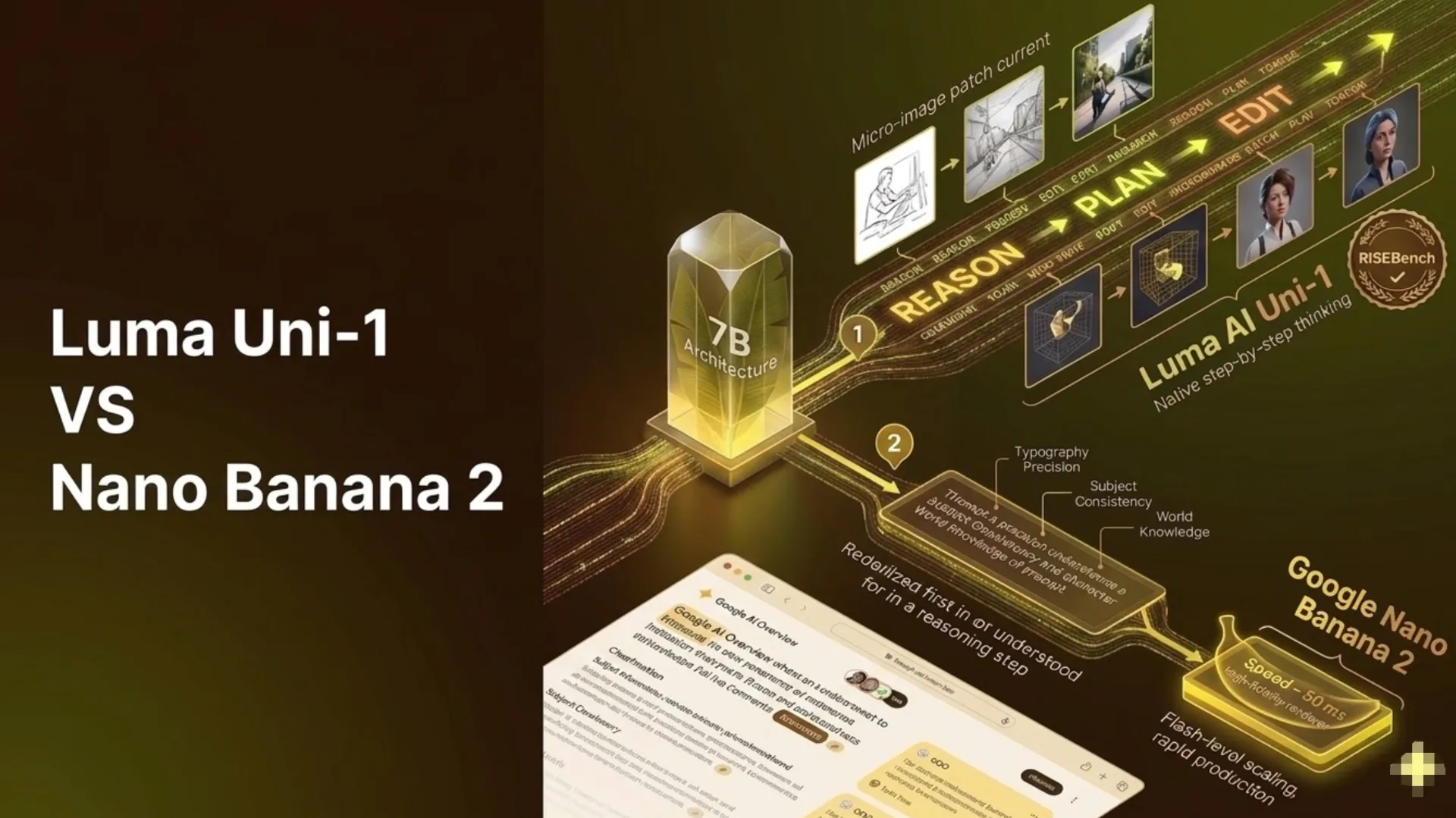
Key Takeaways
- Reasoning & Complex Edits: Luma AI Uni-1 leads with state-of-the-art performance on RISEBench thanks to structured internal reasoning before generation.
- Speed & Production Efficiency: Nano Banana 2 dominates with Flash-level generation times while retaining near-Pro quality and consistency.
- Text Rendering & Consistency: Nano Banana 2 excels at precise typography and multi-subject/object consistency (up to 5 characters and 14 objects).
- Unified Architecture: Uni-1 offers deeper coherence through a single decoder-only autoregressive model that interleaves understanding and generation.
- Best for Creative Depth: Uni-1 for logical planning, causal edits, and complex workflows.
- Best for Scale & Speed: Nano Banana 2 for rapid iteration, commercial content, and accessible production.
Overview of the Contenders
In 2026, AI image generation has split into two clear philosophies. Luma AI’s Uni-1 pursues true multimodal unification, while Google’s Nano Banana 2 optimizes for speed and production readiness within the Gemini ecosystem. Analysis shows these approaches deliver complementary strengths rather than a single winner.
What Is Luma AI Uni-1?
Uni-1 is a decoder-only autoregressive transformer developed by Luma AI. It processes text and image tokens in a single interleaved sequence, enabling simultaneous visual understanding and generation within one forward pass.
The model’s key innovation lies in structured internal reasoning: it decomposes instructions, resolves spatial/causal constraints, and plans compositions before committing to visual tokens. Benchmarks indicate that generation-scale training directly enhances fine-grained understanding, delivering strong results on dense detection tasks such as ODinW-13.
What Is Google Nano Banana 2?
Nano Banana 2, officially Gemini 3.1 Flash Image, combines the high-fidelity capabilities of Nano Banana Pro with the lightning speed of the Gemini Flash family. Released in February 2026, it serves as the default image model across Gemini apps and developer tools.
It emphasizes real-time world knowledge integration, precise instruction following, subject consistency, and production-ready specifications including accurate text rendering and rapid photo editing.
Architecture and Approach Comparison
Uni-1 employs a pure unified autoregressive design. Text and visual patches share the same token vocabulary and attention mechanisms. This eliminates modality alignment issues common in hybrid systems and allows native step-by-step thinking before pixel output.
Nano Banana 2 uses a reasoning-enhanced generation pipeline built on the Gemini 3 family. It applies deep prompt understanding and world knowledge first, then engages an optimized high-fidelity renderer. The architecture prioritizes speed and scale while maintaining Pro-level output quality.
The core difference: Uni-1 builds reasoning natively into the generation process, whereas Nano Banana 2 layers advanced reasoning on top of a fast production engine.
Head-to-Head Performance Breakdown
Speed and Efficiency
Nano Banana 2 consistently generates images in seconds, often 4× faster than previous high-quality models. Uni-1 trades some speed for deliberate internal reasoning steps, making it more suitable for quality-over-quantity workflows.
Reasoning and Logical Edits
Uni-1 achieves state-of-the-art results on RISEBench across temporal, causal, spatial, and logical categories. It excels at physically plausible scene transformations and multi-step reasoning-informed editing.
Image Quality and Realism
Both models produce high-fidelity results. Nano Banana 2 edges ahead in photorealism, lighting consistency, and commercial polish. Uni-1 delivers superior artistic coherence and identity preservation across 76+ styles.
Text Rendering and Typography
Nano Banana 2 demonstrates exceptional text accuracy even in complex layouts, making it ideal for marketing mockups and product visuals.
Subject and Object Consistency
Nano Banana 2 reliably maintains consistency across up to five characters and fourteen objects in single scenes. Uni-1 provides strong reference-guided control but focuses more on logical coherence than sheer quantity of consistent elements.
Best Use Cases and Workflow Recommendations
Luma AI Uni-1 shines in:
- Complex reasoning-informed editing (e.g., aging objects over time or altering causal relationships)
- Multi-turn creative iteration with internal critique and refinement
- Artistic style transfer while preserving exact composition and identity
- Agent-driven creative pipelines requiring deep scene understanding
Nano Banana 2 excels at:
- Rapid high-volume content creation and A/B testing
- Commercial assets with precise text and branding elements
- Fast photo-to-illustration transformations and virtual try-ons
- Production workflows integrated into Gemini and third-party platforms
Advanced Tips and Common Pitfalls
For Uni-1:
- Prompt explicitly for step-by-step reasoning to maximize logical accuracy.
- Supply reference images early in the sequence for stronger grounding.
- Pitfall: Extremely long reasoning chains can increase latency and risk minor error compounding in edge-case scenarios.
For Nano Banana 2:
- Leverage native aspect ratios and detailed environmental context for best results.
- Use for text-heavy or multi-character scenes where consistency matters most.
- Pitfall: Stricter safety filters may reject certain creative or edgy prompts compared to specialized tools.
Conclusion
Luma AI Uni-1 and Google Nano Banana 2 represent the two leading paths forward in 2026 AI image generation: unified multimodal intelligence versus optimized production performance. Uni-1 sets the benchmark for deep reasoning and coherent creative control, while Nano Banana 2 delivers unmatched speed and accessibility for real-world workflows.
Most advanced creators now combine both models — using Uni-1 for conceptual development and complex edits, then Nano Banana 2 for rapid production and scaling. Test both directly on the Luma platform and Gemini ecosystem to identify which approach best matches your specific creative and technical requirements.