
April 24, 2026
DeepSeek V4 vs GPT-5.5: 2026 AI Showdown – Benchmarks, Pricing & Real-World Winners Revealed
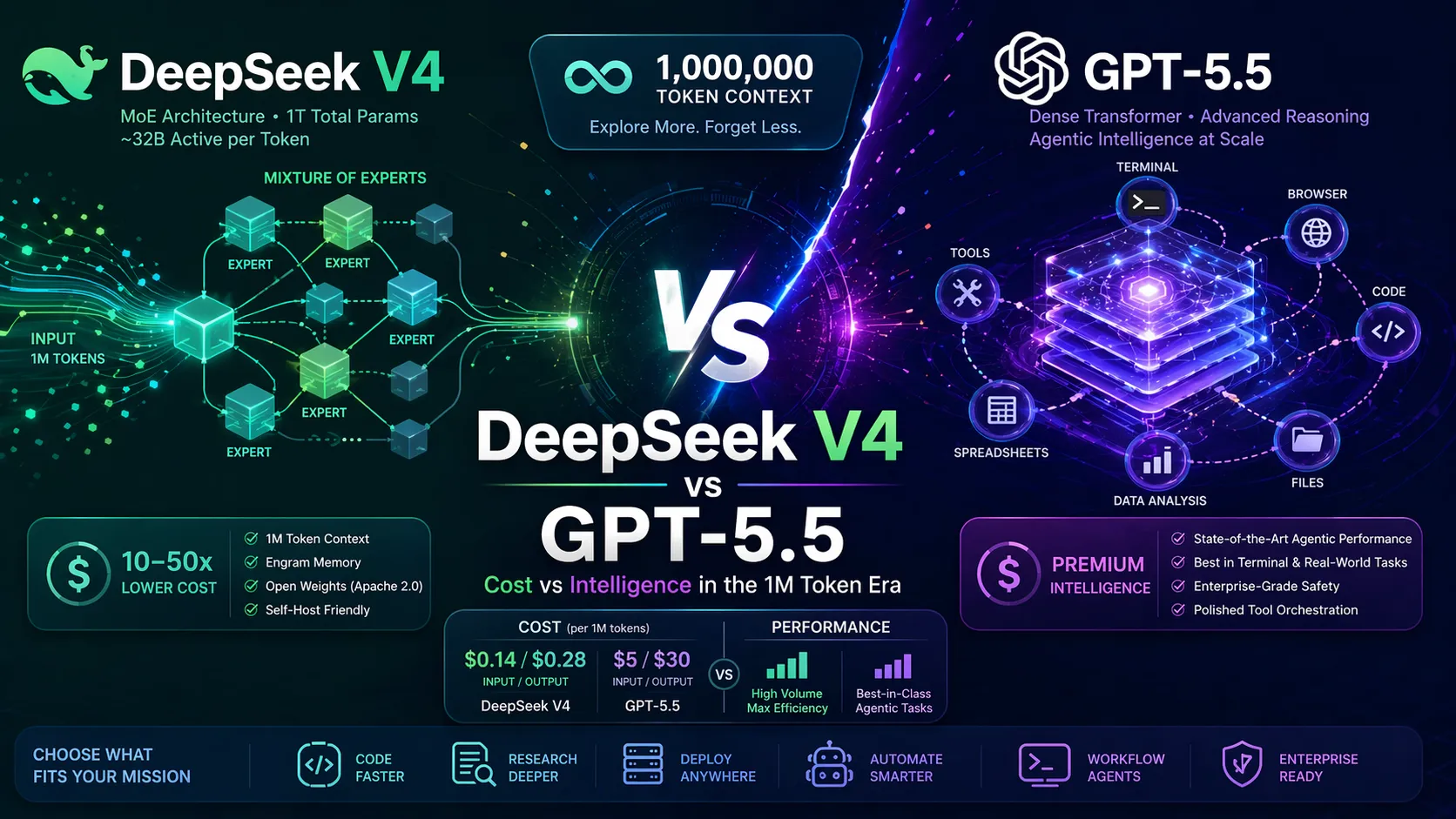
Key Takeaways
- DeepSeek V4 delivers frontier-level coding performance at 10-50x lower cost than GPT-5.5, with a 1M-token context window powered by innovative Engram conditional memory.
- GPT-5.5 leads in agentic task completion, terminal workflows, and complex computer use, achieving state-of-the-art 82.7% on Terminal-Bench 2.0.
- Both models support 1M-token contexts, but DeepSeek V4’s MoE architecture (1T total parameters, ~32B active) offers superior efficiency for long-context coding and research.
- Pricing gap is massive: DeepSeek V4 starts at ~$0.14 input / $0.28 output per 1M tokens versus GPT-5.5 at $5 / $30.
- Best for developers on a budget or self-hosting: DeepSeek V4. Best for production agentic workflows: GPT-5.5.
- Community feedback and early tests indicate DeepSeek V4 closes the gap on raw benchmarks like SWE-bench Verified (~80-85% claimed) while GPT-5.5 excels in end-to-end real-world execution.
Architecture and Technical Specifications
DeepSeek V4 employs a Mixture-of-Experts (MoE) design with approximately 1 trillion total parameters but activates only 32-37 billion per token. This architecture, combined with Multi-head Latent Attention (MLA) and the groundbreaking Engram conditional memory system, enables efficient scaling to a full 1 million token context window without the typical KV cache explosion.
In contrast, GPT-5.5 builds on OpenAI’s proprietary dense transformer lineage with advanced reasoning optimizations. It maintains the same per-token latency as its predecessor (GPT-5.4) while delivering higher capability, supporting 1M input tokens in the API (400K in Codex) and up to 128K output tokens.
Both models feature native tool calling, JSON mode, and streaming. DeepSeek V4 adds hybrid thinking modes and is expected to ship with open weights under an Apache 2.0-style license, enabling self-hosting on consumer hardware clusters. GPT-5.5 remains fully closed-source with enterprise-grade safeguards.
Benchmark Performance Head-to-Head
Benchmarks reveal a nuanced battle between cost-optimized scale and polished agentic intelligence.
Coding & Software Engineering
- DeepSeek V4 pre-release claims show ~90% on HumanEval and 80-85% on SWE-bench Verified, positioning it alongside or slightly behind top closed models but at dramatically lower cost.
- GPT-5.5 scores 58.6% on SWE-bench Pro and 73.1% on OpenAI’s internal Expert-SWE (20-hour median human tasks), demonstrating superior end-to-end issue resolution.
Agentic & Complex Workflows
- GPT-5.5 dominates Terminal-Bench 2.0 at 82.7% (vs. competitors in the 68-69% range), excelling at multi-step command-line planning, iteration, and tool coordination.
- DeepSeek V4’s strength lies in pure reasoning and math-heavy coding, where its Engram memory reduces “forgetting” in ultra-long contexts.
General Intelligence
- GPT-5.5 tops GDPval (84.9% wins/ties), OSWorld-Verified (78.7%), and FrontierMath Tier 4 (35.4%).
- Analysis shows DeepSeek V4’s MoE efficiency shines in high-volume inference scenarios where GPT-5.5’s higher per-token intelligence comes at a premium.
These results highlight a clear divide: DeepSeek V4 for raw capability-per-dollar, GPT-5.5 for reliable, production-ready agentic performance.
Pricing and Cost Efficiency
The pricing disparity defines the 2026 landscape.
DeepSeek V4-Pro and Flash variants price at approximately $0.14–$0.30 per 1M input tokens and $0.28–$0.50 output (with cache-hit discounts as low as $0.028). This makes large-scale codebases, documentation analysis, or agent fleets economically viable.
GPT-5.5 lists at $5 input / $30 output per 1M tokens ($30/$180 for Pro tier). While batch and priority options exist, the 10-50x cost multiplier means GPT-5.5 suits high-stakes, lower-volume workflows where accuracy and safety justify the expense.
For teams processing millions of tokens daily, DeepSeek V4 can reduce API bills by orders of magnitude—often the deciding factor for startups and research labs.
Context Handling, Speed, and Efficiency
Both reach 1M tokens, but implementation differs.
DeepSeek V4’s Engram system separates static knowledge from dynamic reasoning, maintaining near-constant inference speed even at maximum context. This proves ideal for analyzing entire repositories, legal contracts, or research corpora.
GPT-5.5 matches predecessor latency while using fewer tokens overall for the same tasks, thanks to improved planning. Its computer-use capabilities allow seamless navigation across apps, spreadsheets, and terminals.
Edge case insight: In 1M-token retrieval tasks, DeepSeek V4’s conditional memory minimizes hallucinations more effectively than traditional attention mechanisms.
Use Cases: When to Choose Each Model
Choose DeepSeek V4 for:
- High-volume coding agents and test generation
- Long-context research or document synthesis
- Self-hosted deployments or cost-sensitive production
- Multilingual and math-heavy workloads
Choose GPT-5.5 for:
- Complex agentic workflows requiring tool orchestration and verification
- Professional software engineering with real GitHub issues
- Enterprise environments needing strongest safety guardrails
- Tasks involving computer use, data analysis, and multi-app execution
Advanced tip: Many teams now adopt a hybrid approach—using DeepSeek V4 for initial drafting and heavy lifting, then GPT-5.5 for final validation and deployment.
Strengths, Weaknesses, and Common Pitfalls
DeepSeek V4 Strengths: Unbeatable price/performance, open ecosystem potential, exceptional long-context retention. Weaknesses: Slightly behind on the newest agentic benchmarks; multimodal input still maturing compared to Western leaders.
GPT-5.5 Strengths: Best-in-class agentic intelligence, polished tool integration, rapid iteration without latency penalties. Weaknesses: High cost limits experimentation; closed nature restricts customization.
Common Pitfalls to Avoid:
- Over-relying on long context without proper chunking—both models can still lose needle-in-haystack details at extreme lengths.
- Ignoring cache pricing on DeepSeek V4, which can cut costs another 80% on repetitive prompts.
- Deploying GPT-5.5 without monitoring token usage—its higher intelligence often leads to more verbose but higher-quality outputs.
- Neglecting hybrid prompting: Combine DeepSeek’s speed with GPT-5.5’s reasoning for optimal results in production pipelines.
Conclusion
The 2026 AI landscape no longer revolves around a single “best” model. DeepSeek V4 democratizes frontier performance through radical cost efficiency and architectural innovation. GPT-5.5 pushes the boundary of what autonomous agents can achieve in real-world environments.
For most developers, researchers, and businesses, the winning strategy involves evaluating both via their respective APIs. Start with DeepSeek V4 for rapid prototyping and scale, then layer GPT-5.5 where precision and agentic reliability matter most.
Test the models today at DeepSeek API and OpenAI’s platform to discover which—or which combination—transforms your workflow.