
March 15, 2026
ByteDance Halts Global Launch of Seedance 2.0 Amid Disney Copyright Dispute
Key Takeaways
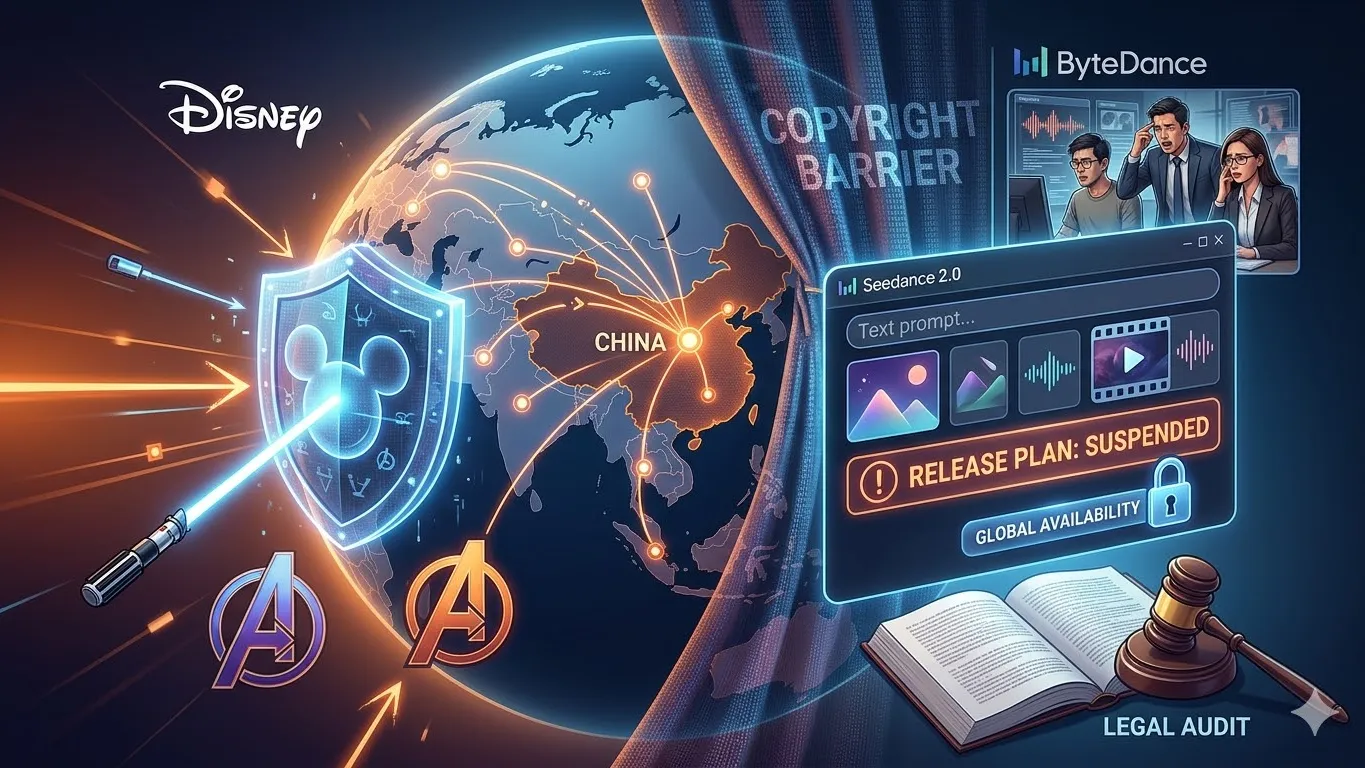
- Release Plan Suspended: ByteDance’s planned mid-March global availability for Seedance 2.0 has been halted due to copyright issues; the tool remains limited to the Chinese market.
- Disney’s Core Allegations: On February 13, Disney sent a formal cease-and-desist notice, accusing the model of being trained on unlicensed “pirated material libraries” that included Marvel, Star Wars, and other IPs treated as public-domain assets.
- Technical Highlights: Supports text, images (up to 9), video (total 15 seconds), and audio (up to 3 tracks) multi-modal input; generates native-audio multi-shot cinematic clips with superior physics realism and lip-sync.
- Response Measures: ByteDance’s legal team is auditing risks while engineers strengthen safeguards, including temporarily disabling high-risk reference uploads for real people and video clips.
- Industry-Wide Ripple: The incident highlights training-data compliance challenges for generative AI, likely raising barriers for Chinese tools entering global markets and accelerating the shift toward licensed and synthetic datasets.
Seedance 2.0 Technical Breakdown: Why It Became a Copyright Target
Seedance 2.0 is ByteDance’s latest unified multi-modal audio-video generation architecture. It delivers precise natural-language control over camera motion, lighting, physics, and scene consistency. Benchmarks show it leads in reference-driven generation, simultaneously handling multiple reference images, short video clips, and audio tracks for seamless video extension and multi-shot editing.
Compared with OpenAI’s Sora and Runway Gen-4, Seedance 2.0 stands out in joint audio-video generation and lip synchronization, outputting 1080p to 2K resolution clips lasting 5–15 seconds. Analysis indicates this high level of control and realism drove its rapid popularity in China—users quickly created viral deepfake videos featuring Hollywood stars and Disney characters.
Yet that same “boundary-free reference” capability made the model vulnerable during training, turning it into a direct target for Hollywood IP holders.
Timeline: From Chinese Viral Success to Global Blockade
- Early February: Seedance 2.0 launched in China and exploded in popularity thanks to hyper-realistic physics and native audio features. Deepfake videos of major Hollywood stars spread rapidly on social platforms.
- February 13: Disney formally notified ByteDance’s global general counsel, alleging the model’s built-in “pirated material library” treated protected IPs such as Star Wars and Marvel as free stock footage.
- Mid-February: ByteDance responded by pledging respect for intellectual property and pausing several high-risk features.
- Mid-March: According to reports from The Information and Reuters, the originally scheduled global release was abruptly canceled. Legal and engineering teams are now working in parallel to identify risks and upgrade filtering mechanisms.
The swift sequence illustrates the regulatory gap: Chinese先行 testing versus immediate collision with Hollywood’s strict IP enforcement upon global expansion.
Root Cause Analysis: The Legal Gray Zone of AI Training Data
Disney and other studios argue that Seedance 2.0 not only copied protected characters during pre-training but also enables users to generate highly realistic derivative works, constituting large-scale reproduction, distribution, and adaptation infringement.
This dispute is not isolated; it reflects a broader challenge facing generative AI: whether training data qualifies as fair use. U.S. courts are actively litigating similar cases against Midjourney and Stability AI, while China’s Supreme People’s Court is drafting related judicial interpretations in 2026. ByteDance’s decision to pause global rollout buys time to strengthen compliance frameworks and avoid cross-border litigation.
Edge cases matter: even without explicit prompts, models can “memorize” IP features from massive internet datasets and still produce infringing output. Right-of-publicity claims involving celebrities can compound copyright issues, dramatically raising legal exposure.
Industry Impact and Lessons: New Power Dynamics in the AI Video Race
Benchmarks indicate the pause will temporarily hinder ByteDance’s ability to compete head-to-head overseas with Sora and Runway, potentially fragmenting the market—Chinese users retain access to cutting-edge tools while global creators shift to more conservative compliant platforms.
The deeper effect is accelerated industry-wide compliance evolution: future AI companies will likely prioritize licensed asset libraries, synthetic data pipelines, or direct studio partnerships. Community feedback shows filmmakers and advertisers are already evaluating “copyright insurance” and watermark-tracking technologies to mitigate commercial risk.
For ByteDance, the delay slows international expansion but preserves integration opportunities within the TikTok ecosystem and forces technical iteration toward “safety-first” design.
Creator Compliance Guide: Practical Strategies and Common Pitfalls
- Use Only Original References: Upload solely your own images, videos, and audio; never use recognizable IP characters or celebrity likenesses as input.
- Post-Generation Review: Immediately inspect outputs for protected elements and run official or third-party detection tools when needed.
- Check Terms Before Commercial Use: Even within China, monitor updated platform agreements—especially for advertising or export scenarios.
- Consider Compliant Alternatives: Switch to models partnered with rights holders or use locally fine-tuned tools with verified legal datasets.
- Avoid Common Misconceptions: “Entertainment only” or “AI generated automatically” does not grant legal immunity—court precedents hold both users and platforms jointly liable for derivative infringement.
These steps reduce legal exposure while preserving the productivity gains of generative AI.
Conclusion
ByteDance’s suspension of Seedance 2.0’s global release marks the transition of generative AI from rapid technical advancement to rigorous compliance competition. It serves as a clear reminder to the entire industry: innovation velocity must match intellectual-property safeguards, or global market access will remain blocked.
Filmmakers, advertisers, and developers should monitor ByteDance’s official updates closely and prioritize compliant tools for long-term content strategies. In the AI era, compliance itself is a competitive advantage—embrace it now to secure your position in the video generation landscape.