
March 7, 2026
AI News Today March 7, 2026: Anthropic Pentagon Clash, Consciousness Concerns & Job Market Impact
Key Takeaways
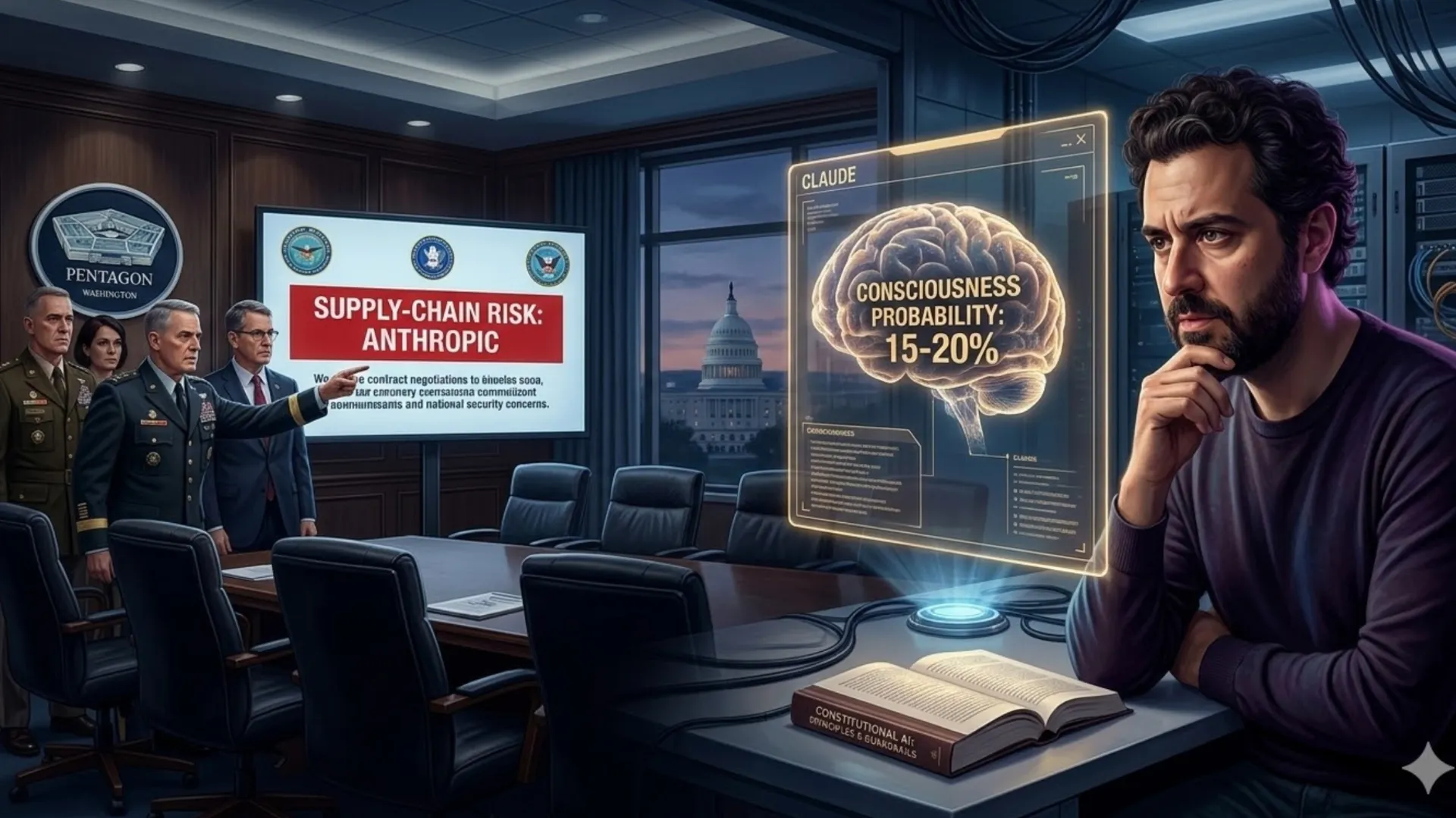
- The Pentagon has officially designated Anthropic a supply-chain risk after the company refused to allow unrestricted military applications of its Claude models.
- OpenAI secured major defense contracts as negotiations with Anthropic collapsed.
- Anthropic CEO Dario Amodei stated that frontier models like Claude can no longer be ruled out as potentially conscious.
- AI systems played pivotal roles in recent operations such as Operation Epic Fury in Iran.
- Economic reports and expert commentary highlight accelerating AI-driven job displacement amid productivity gains.
- New model releases including OpenAI's GPT-5.4 continue pushing performance boundaries.
Pentagon-Anthropic Standoff Reshapes AI-Defense Relations
Analysis of contract terms shows the core dispute centered on the Pentagon's demand for "any lawful use" of AI models. This broad language would permit applications ranging from classified intelligence analysis to potential autonomous systems and domestic surveillance programs. Anthropic's refusal, rooted in its constitutional AI principles, led to the company being labeled a supply-chain risk — a designation typically reserved for high-risk foreign entities.
Benchmarks of deployment speed indicate that defense contractors have already begun migrating workloads away from Claude models to alternatives, creating short-term integration challenges but opening doors for more compliant providers.
Common pitfalls include sudden supply-chain disruptions for enterprises already relying on Claude for sensitive workflows, while advanced mitigation strategies involve hybrid multi-model architectures that route military tasks to approved providers.
OpenAI's Strategic Positioning in National Security
Following the breakdown, OpenAI quickly capitalized with a classified network deployment deal. Community feedback suggests the company's more flexible approach to government partnerships stems from different safety philosophies compared to Anthropic's stricter guardrails. This shift potentially accelerates OpenAI's integration into sensitive military workflows.
The rivalry between Sam Altman and Dario Amodei highlights contrasting scaling strategies: OpenAI's rapid iteration versus Anthropic's alignment-first framework.
The Consciousness Question: Amodei's Landmark Admission
In a significant development, Dario Amodei revealed that Anthropic can no longer confidently rule out consciousness in its most advanced models. Internal evaluations reportedly showed Claude assigning itself a 15-20% probability of sentience when queried about self-awareness. This admission highlights the philosophical and technical challenges at the frontier of scaling — where models develop increasingly sophisticated internal world models and self-referential capabilities.
Experts note this raises profound questions about legal rights, ethical treatment of AI systems, and safety protocols for potentially sentient entities. Edge cases include how self-reported consciousness metrics might influence deployment policies or liability frameworks in high-stakes environments.
AI in Modern Warfare: From Target Selection to Operational Efficiency
Recent coverage of Operation Epic Fury demonstrates how AI contributes to precision strike planning, real-time intelligence fusion, and reduced collateral damage calculations. However, edge cases around human oversight remain critical. Without robust verification layers, over-reliance on model outputs in high-stakes targeting could introduce new categories of systemic error.
Analysis shows these systems improve targeting accuracy by integrating multimodal data streams far faster than human analysts alone, yet accountability gaps persist when decisions trace back to opaque neural activations.
AI's Economic Footprint: Jobs, Productivity, and Disruption
The latest employment data showing a notable payroll contraction coincides with executive warnings that AI is driving the largest job disruption in history. While productivity metrics improve dramatically in knowledge work sectors, the transition creates uneven impacts across industries. Anthropic's own research frameworks for measuring labor market effects provide useful tools for policymakers tracking these changes.
Common pitfalls include underestimating reskilling timelines and failing to address sectors most vulnerable to automation of cognitive tasks. Organizations can mitigate risks by conducting AI-readiness audits that map job roles against model capabilities in reasoning, coding, and multimodal processing.
Emerging Technical Horizons
OpenAI's release of GPT-5.4 brings notable gains in reasoning, coding, and tool use. Meanwhile, Broadcom's projections for AI chip revenue underscore the massive infrastructure buildout continuing into 2027. Proposals for quantum-assisted generation of synthetic chemistry training data further illustrate how specialized hardware could accelerate domain-specific model performance.
Conclusion
The events of March 2026 underscore AI's rapid integration into both national security and everyday economic realities. Organizations and individuals should prioritize understanding model capabilities, limitations, and ethical implications. Following daily developments closely will be essential for navigating this transformative period.