
March 3, 2026
AI News Today March 3, 2026: Meta's Digital Afterlife Patent, AI in Military Ops, and MWC 2026 AI Network Breakthroughs
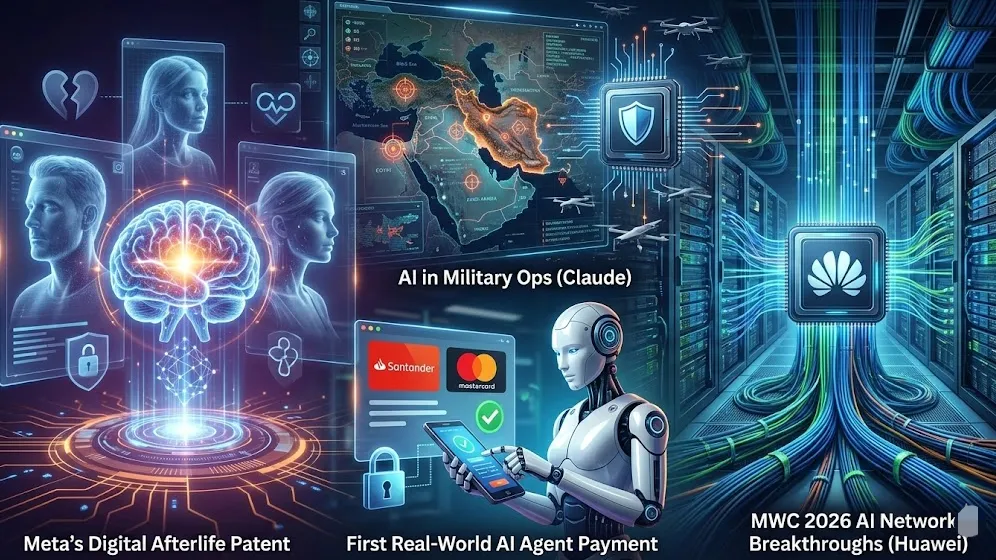
Key Takeaways
- Meta's controversial patent enables AI simulation of deceased users' social profiles, raising ethical concerns about grief and digital immortality.
- Military AI integration advances with Anthropic's Claude supporting US intelligence and targeting in recent Iran operations.
- MWC 2026 highlights include Huawei's next-gen AI-native optical networks and industry shifts toward agentic AI in public sectors.
- First AI agent payment completed by Santander and Mastercard signals growing real-world autonomous AI finance applications.
- Infrastructure demands continue surging, with rethinking storage-compute architectures and massive investments in AI data centers.
Meta Patents AI for 'Digital Afterlife' on Social Profiles
Meta received a patent (granted late 2025, filed 2023) describing a large language model that simulates a user's social media behavior posthumously or during inactivity. The system analyzes past comments, likes, and posts to generate responses, potentially extending to simulated video or audio interactions.
Benchmarks indicate this technology could maintain profile activity indefinitely, but experts highlight risks: it may complicate natural grief processes by creating persistent digital echoes of the deceased. Community feedback suggests psychological impacts include prolonged attachment or distorted mourning, with some comparing it to speculative 'digital resurrection' concepts.
Implementation challenges involve consent mechanisms, data privacy post-mortem, and preventing misuse for fraud or manipulation. While innovative for legacy preservation, the approach underscores the need for robust ethical frameworks in persistent AI identities.
Anthropic's Claude AI Supports US Military Targeting in Iran Strikes
Analysis shows Anthropic's Claude model played a role in intelligence analysis and targeting during recent US operations against Iran (referred to as Operation Epic Fury). Axios reporting details how the AI assisted in processing data for precision strikes.
This development highlights accelerating military adoption of frontier AI models. While providing efficiency in data-heavy intelligence tasks, it sparks debate over safety boundaries, accountability in autonomous decisions, and alignment with ethical deployment guidelines.
Common pitfalls include over-reliance on AI outputs without human verification, potential biases in training data affecting targeting accuracy, and escalation risks in geopolitical contexts. Benchmarks from similar deployments indicate improved speed but emphasize layered oversight to maintain human-in-the-loop protocols.
MWC 2026: Huawei Launches AI-Centric Optical Networks for AI Era
At MWC Barcelona 2026, Huawei introduced next-generation optical network products designed to synergize with exploding AI demands. The solutions advance toward AI-centric all-optical networks, optimizing bandwidth, latency, and energy for massive AI workloads.
Key innovations focus on intelligent routing and resource allocation tailored to AI traffic patterns. Industry analysis shows these advancements address bottlenecks in hyperscale data transmission, where traditional architectures struggle with inference and training scale.
Edge cases include ultra-low-latency requirements for real-time agentic AI and distributed training across continents. Advanced tips: operators should prioritize AI-aware traffic engineering to maximize ROI on optical investments.
First Real-World AI Agent Payment Marks Financial Milestone
Santander and Mastercard completed the first documented payment executed by an autonomous AI agent. This breakthrough demonstrates agentic AI moving beyond simulation into regulated financial environments.
The transaction highlights capabilities in secure, compliant execution without constant human intervention. Why it matters: it validates agent reliability in high-stakes domains, paving the way for automated expense management, supply-chain payments, and personalized finance.
Potential pitfalls involve regulatory compliance, error recovery in failed transactions, and auditability of agent decisions. Community feedback suggests starting with low-value, monitored pilots before scaling to enterprise volumes.
Public Sector and Enterprise Shift to Agentic AI Readiness
Capgemini research reveals nearly 90% of public sector organizations plan to explore or implement agentic AI within 2-3 years. The focus transitions from pilot ambition to operational readiness, emphasizing trusted integration.
In enterprise contexts, rethinking storage-compute divides becomes critical as AI workloads expose inefficiencies in traditional architectures. Smart storage solutions that process data closer to compute resources show promise for reducing latency and energy use.
Advanced insights: hybrid approaches combining passive archival with active, AI-optimized tiers yield best performance. Common pitfalls include underestimating power and cooling demands in agentic deployments.
Broader AI Landscape: Infrastructure Boom and Ethical Tensions
US Big Tech's projected $650 billion AI infrastructure spend in 2026 underscores the scale of compute demands. Meanwhile, regional impacts appear, such as AI automating white-collar processes in India, potentially shrinking traditional outsourcing models.
Ethical tensions persist around military use, posthumous simulation, and autonomous agents in finance. Analysis indicates balanced governance—combining technical safeguards with policy oversight—will determine sustainable adoption.
Conclusion
March 3, 2026, underscores AI's dual trajectory: transformative capabilities in networks, finance, and defense alongside profound ethical questions in identity and warfare. Staying informed on these rapid developments remains essential for professionals navigating the AI landscape.
Stay ahead—bookmark this site for daily AI updates, explore agentic tools in your workflows, and engage in community discussions on responsible deployment. The AI evolution accelerates; informed adaptation drives advantage.