
February 12, 2026
GLM-5: China's Open-Source Frontier Model Narrowing the Gap to Claude Opus 4.5
Key Takeaways
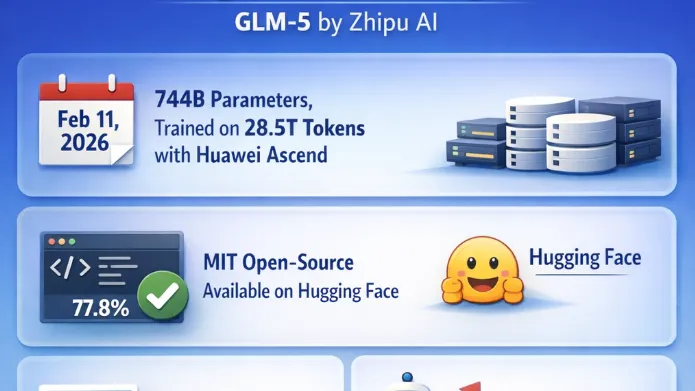
- Released February 11, 2026 by Zhipu AI (Z.ai): 744B total parameters (40B active MoE), pre-trained on 28.5T tokens using Huawei Ascend hardware.
- MIT open-source license — full weights available on Hugging Face (zai-org/GLM-5) for unrestricted commercial and local deployment.
- Coding performance — 77.8% on SWE-bench Verified (outperforms Gemini 3 Pro at 76.2%, trails Claude Opus 4.5 at 80.9%); 56.2% on Terminal-Bench 2.0.
- Agentic benchmarks — Leads open models on Vending Bench 2 ($4,432 final balance) and BrowseComp (75.9); strong long-horizon planning capabilities.
- Reliability milestone — Achieves score of 50 on Artificial Analysis Intelligence Index (first open model above 50) and record-low hallucination rate (AA-Omniscience -1).
- Context & efficiency — 200K token context window with DeepSeek Sparse Attention (DSA) for cost-effective long-context inference; 128K max output.
- Strategic importance — Fully trained on domestic chips, offering supply-chain independence amid export restrictions.
GLM-5 marks Zhipu AI's shift from rapid code generation to robust agentic engineering, enabling models to handle complex, multi-step software systems and extended autonomous tasks.
Benchmarks and architecture indicate a significant reduction in the performance difference to closed frontier models like Claude Opus 4.5, particularly in coding reliability and agent endurance.
Architecture & Training Innovations
GLM-5 employs a Mixture-of-Experts (MoE) design with 744B total parameters and 40B active during inference (256 experts).
Compared to GLM-4.5 (355B total / 32B active), the model scales substantially while integrating DeepSeek Sparse Attention (DSA) to maintain 200K context at lower memory and compute cost.
Pre-training expanded to 28.5T tokens. Post-training leverages the open-source slime asynchronous RL framework (github.com/THUDM/slime), improving efficiency for fine-grained reinforcement on long trajectories.
Why this matters — DSA enables practical deployment of long-context agents without prohibitive hardware demands, while slime RL supports denser alignment for complex reasoning.
Trade-off — Native BF16 release (~1.5 TB) requires significant resources for self-hosting; community FP8 quantizations mitigate this but may impact precision in code-critical use.
Benchmark Performance Overview
GLM-5 claims top open-weight rankings across key evaluations (February 2026 data):
Coding
- SWE-bench Verified — 77.8% (beats Gemini 3 Pro 76.2%; Claude Opus 4.5 leads at 80.9%)
- Terminal-Bench 2.0 — 56.2% (verified up to 60.7% in select configs)
Agentic & Long-Horizon
- Vending Bench 2 — $4,432 final balance (top open model, competitive with Claude Opus 4.5)
- BrowseComp — 75.9 (strong with context management)
- Artificial Analysis Agentic Index — 63 (highest among open models)
Reasoning & Reliability
- Artificial Analysis Intelligence Index — 50 (first open model ≥50)
- Humanity’s Last Exam — 30.5 (text-only); 50.4 (with tools)
- Hallucination — Lowest tested rate (AA-Omniscience -1)
These results position GLM-5 as the leading open model in reasoning density and knowledge abstention.
GLM-5 vs Claude Opus 4.5: Direct Comparison
- Coding depth — GLM-5 closes to ~3 points on SWE-bench Verified; self-correction and planning narrow the practical gap for many engineering tasks.
- Agent endurance — Competitive on long-horizon simulations (Vending Bench, BrowseComp); Opus 4.5 retains edge on extreme multi-day scenarios.
- Reliability — GLM-5's hallucination reduction and abstention strength often outperform in knowledge-sensitive workflows.
- Cost & deployment — Open weights + inference at ~$1 input / $3.20 output per million tokens (via hosts) provide 5–10× savings at scale vs proprietary APIs.
- Limitations — Text-only modality (multimodal in separate GLM lines); higher token usage from extended thinking steps.
The remaining gap favors GLM-5 for open, sovereign, or high-volume needs.
Advanced Usage Tips & Pitfalls
- Thinking mode — Enable via system prompt or API flag to maximize step-by-step reasoning and minimize errors on complex prompts.
- Context caching — Essential for 150K+ token agent loops; significantly reduces redundant prefix costs.
- Quantization guidance — FP8 versions perform reliably on 4–8 high-end GPUs via vLLM; avoid aggressive INT4 for precision-sensitive coding.
- Common pitfall — Deeper reasoning increases token consumption (1.5–2× vs lighter models) — monitor usage closely.
- Edge strength — Exceptional abstention behavior reduces fabricated outputs when uncertain.
Ideal Use Cases
- Large-scale software refactors and full-system development.
- Long-running autonomous agents and orchestration frameworks.
- Enterprises requiring unrestricted models or domestic hardware compatibility.
- Cost-sensitive high-volume inference workloads.
Getting Started
- Free access — chat.z.ai (select GLM-5)
- API — api.z.ai (OpenAI-compatible, model: glm-5)
- Weights download — Hugging Face zai-org/GLM-5 (MIT license)
- Local inference — vLLM, SGLang, or compatible setups
- Agent integration — Compatible with OpenClaw, Claude Code-style tools
Conclusion
GLM-5 demonstrates that open-source models can achieve near-frontier performance in agentic engineering and coding reliability, significantly closing the gap to Claude Opus 4.5.
With unmatched openness, cost efficiency, and supply-chain resilience, it redefines viable options for production-grade AI systems.
Explore GLM-5 today at chat.z.ai or download the weights from Hugging Face to evaluate its capabilities on real workflows.